
When I was young I had a tendency to have a lot of nose bleeds as children apparently often do. I remember one particular bad morning when I was preparing to go to school when I started bleeding from my nose in the bathroom, and it would not stop. The rest is kind of a blur. I remember just sitting on the floor of the bathroom holding a packet of frozen peas wrapped in a towel up to my nose. When it was clear the nosebleed was not going to stop we went to the nearest children’s clinic, thus making sure I skipped school that day. After the visit to the clinic with one less nosebleed, but feeling a bit woozy and drained because of the blood loss we decided to go to the local shopping mall.
The place isn’t as shabby as it was then, and it has had a massive makeover because of the metro station now contained inside of it, but when I was little it really was not the place to hang out, it was more like the “go do the necessary thing and leave”. Well, I remember passing by some local kiosk where there were books for sale displayed outside on a rack and one of them was Memoirs of a Geisha by Arthur Golden. The film had just come out I think, and so I remember the black background and the haunting stare of a pure white face searing it into my brain. I was too young to see the film, too unaware and naive to care much about it or cinema or the world at large. Yet I still vividly remember that film tie-in book cover staring back at me as I walked past it.
Spoilers for the film below!
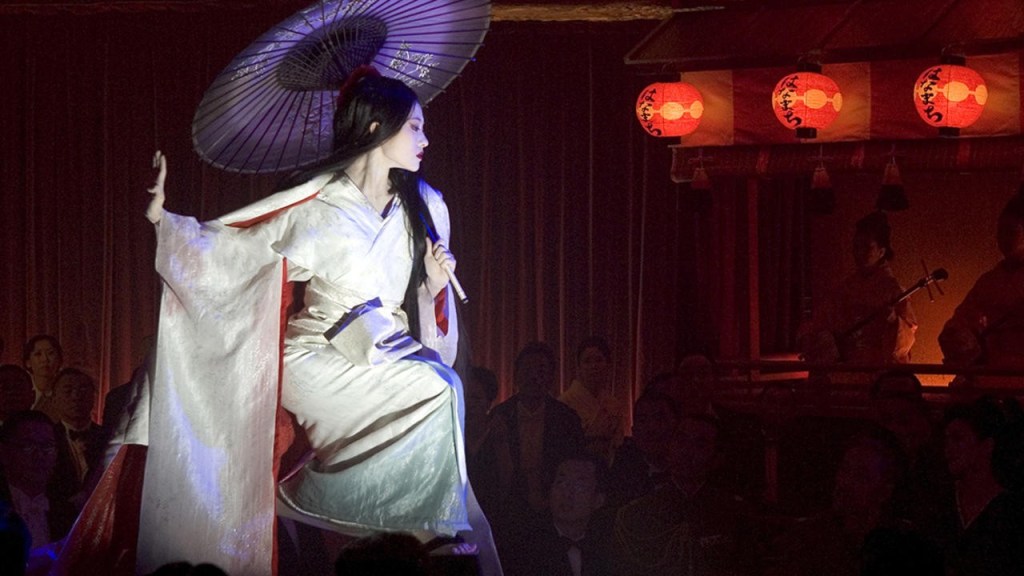
Memoirs of a Geisha the film is an intersectionality of many things, mostly bad ones, and I hope I can do them justice here. Based on the bestselling historical fiction 1997 book by Arhur Golden the story is about Chiyo, a young girl with blue eyes, sold to an okiya (geisha house) in pre Word War II Japan where she works as a servant and meets a man only called the Chairman whose interaction shapes her whole life. In her young life she is under the rule of Hatsumomo, one of the most popular geishas in Gion, and becomes friends with an excited Pumpkin who cannot wait to be a geisha. The two form a bond, and a rivalry as when Chiyo’s circumstances change when she is given the opportunity by Mameha, another popular geisha, to be under her tutelage to make sure she becomes the most popular geisha in Gion. Her name is changed to Sayuri in a ceremony, and she meets the Chairman again, this time more determined than ever to be a part of his life even though she has to entertain his best friend Nobu. She goes through with selling her mizuage (don’t worry we’ll get to it), essentially loosing her virginity, and learns the power plays of the geisha profession easily, ultimately surpassing Hatsumomo who falls from grace. Then World War II happens, and when Sayuri comes back into the life of a geisha, she finds the world has changed. Pumpkin betrays her trust, and in the end she learns that it was the Chairman who sent Mameha to her okiya door, making her a geisha. He becomes her danna (patron) and she moves with him to New York city. Happy ending all around, all wrapped up in long languishing sentences and beautiful descriptions befitting an Orientalist dream coming from a white man essentially writing as a Japanese woman with the book’s first person narration.
The book made a big impression on me when I first read it, especially the scene in one of the beginning chapters where Chiyo sees her elder sister being intimate with a boy while she watches. Then there is the whole eel and cave dialogue in a thinly metaphor for sex. Yeah, reading this as an impressionable young girl definitely shaped me into loving purple prose and interest in learning about the differences between different kinds sex work and artistic entertainment made by women in different cultures. It also made me more interested in Japanese culture, making me essentially binge the Begin Japanology series when I discovered it.
Sex and passion run through this novel in a sorta restrictively trashy way that you know was added just to add spice to the narrative, thus making the confusion between a geisha and a prostitute, mudding the waters in the eyes of the West even more, and showing how little Golden really cared for historical accuracy, care for the culture, and for the geisha profession as a whole, since he saw fit to make large inaccuracies in the service of his Cinderella story narrative. Part fairy tale, part history, all Orientalism.
The film and book also mixes up the roles of the different professions such as geisha, oiran (courtesan) and a regular prostitute. Geishas are artisans; dancing and singing and masters in the art of conversation. They entertain, but it is a serious business, not something to be trifled with as Golden did with his book. He interviewed the real and former first class geisha or geiko Mineko Iwasaki for his book, with her expecting him to not name her, since confidentiality and secrecy is what keeps the world of the geishas alive –– and then he did the exact opposite when the book came out. The whole thing became a scandal and Mineko Iwasaki wrote her own book Geisha of Gion or Geisha; A Life to actually tell her side of the story, and what being a geisha truly meant when she was in the profession from the 1950s to the 1980s in Gion. In the book it says that “A young oiran also underwent a ceremony called mizuage but hers consisted of ceremonially deflowered by a patron who had paid handsomely for the privilege. This alternative definition of mizuage has been a source of some confusion about what it means to be a geisha.”
And the mizuage ceremony is more about a maiko becoming a geisha than a losing of her virginity since the outlawing of prostitution in 1956 in Japan which forbade the former practice in a physical sense as some disreputable okiyas had done in the past in some other districts, but never Gion. “At her mizuage ceremony, the topknot is symbolically cut to denote her transition from girlhood to young womanhood and she assumes more of an adult hairstyle.” The memoir is a fascinating read, which makes one realize how much of Mineko’s real life Golden lifter for his own fantasy about geisha, and how much a better film would have become of the life story of Mineko herself than the fictional blue eyed Sayuri.
It is more of a symbolic practice than a physical one. Indeed, it is seen as a disgrace if a man spends the night in an okiya, since it would put the women’s reputation in disrepute. And the danna (patron) system is more of a business agreement, than a sexual one. Art is paramount most of all, nothing else. The South Asian equivalent would be the Tawaif and for West the courtesans and the Hetaira in Ancient Greece; women concentrating on the art of etiquette, poetry, word play, dance, song etc. Because we cannot imagine an artisan without the passion of an artist sex inevitably comes into play in the fantasies, when the art of reaching the ultimate perfection in a demanding profession such as the one required of those which I mentioned is not befitting enough for the audience hungry for love and ultimately makes the case against professional women in these jobs. When will just being good in a profession not be seen as enough? Must there inevitably be the fantasy that sex is always a part of life, when there are certainly people in this world who are happy living without having either experienced or wanting to experience that part?
In contrast to Mineko Iwasaki there was the geisha Sayo Masuda who wrote Autobiography of a Geisha which was published in 1957. I write about her here, since in the words of Chimamanda Ngozi Adichie’s A Single Story TED Talk there is a danger in putting on a single narrative and the world is a complex place. Mineko Iwasaki might have had the life of a privileged geisha at her time with her being able to meet with world leaders and princes, but Sayo Masuda was working before her in a different reality from Iwasaki. Masuda was sold to an okiya, and she went through the physical mizuage ceremony four times to make her okiya a lot of money, and was the first geisha to write about her experiences even though Iwasaki is credited in being the first geisha to talk about them, when it is not the case. Masuda’s reality was what it was like to work at a less reputable okiya in a different district before the outlawing of prostitution in Japan in 1956; a thing which she opposed, since she knew people would find ways around it anyway, and she herself had stated that she would not have survived if not for doing sex work. Masuda’s version of reality is one, Iwasaki’s is another, they I do not think fight one another, more like they are having a conversation. Both were in the same profession, both wrote a book, but while Iwasaki’s reflects the world of the geisha after 1956 in a high class okiya, Masuda’s is a stark reminder of what the profession was like for some women in less prestige okiyas in other districts where the definitions of the same ceremonies were muddled from their true artistic and symbolic meaning, blurring the lines between realities. Not to mention when prostitutes decided to call themselves “geisha girls” during the American Occupation of Japan, which blurred the lines even more, and gave Americans a sexualized idea of the artisans.
And now I can finally dive fully into the film, which is a visual treat for the eyes and ears. The score by John Williams is especially memorable, with the flutes and other instruments weaving an earworm of a tune, with my favorite being the popular ‘Becoming a Geisha’. I remember at one point watching the film as a kind of comfort watch, knowing it is essentially an Orientalist fantasy, and that is why I consider it a guilty pleasure. I know it is bad plot-wise, yet because it is stunning visually, and the acting is good, it makes it a very watchable film even for all of its massive inaccuracies. Honestly, the more you know about Japan or are Japanese, the less you will like this film. I know all of those facts which I have written here already, yet I still like the film. I am allowed to like BAD things, we are allowed to like them, as long as we acknowledge the problems within the thing and look at it critically. So, have I earned liking this film by knowing those long historical facts, and fully knowing that it is essentially a historical fantasy film that bloomed from the imagination of white men? Tell me in the comments what you think.
The visuals and the beautiful technical aspects of the film from the coloring, the lighting (the beautiful dark, but soft shadows), (inaccurate yet) beautiful costuming and hairstyling, and just how beautiful every single frame is in the film thanks to the production design and cinematography. Rob Marshall is a man who likes to concentrate on choreography and the art of art itself as seen with his musical film ventures, but with this film it seems like he was too caught up in making everything beautiful that he makes a film that is visually appealing, but as we have already discussed, is far from being truly authentic, and is a film which loses its steam in the two hour mark, because the burning of the okiya feels like the climax already.
Because the story of Chiyo then Sayuri rising in the ranks of the okiya, as well as her battle with Hatsumomo and Pumpkin is ultimately which is the most interesting part of the film, the romance with the Chairman is what one could easily describe as creepy and one which has a huge age gap, not to mention the fact that the Chairman is a married man. When reading the book, as well as seeing the film, I honestly could not have cared less for the romance, I was more interested in what it took to become so good in this profession where the true mastery was dealt with in tea houses, in conversation, and selling a fantasy to the person one is speaking to. Giving an impression of liking, yet not giving an inch, because it is all pretend or at least, making sure you feel like the most important person in the room. Iwasaki describes in her book how some men thought she meant more than what she said in a mere professional capacity, and how she would also entertain the men’s wives and girlfriends when they would visit the okiya.
As for the use of Chinese and Malaysian actresses in the roles of Japanese women for the leading roles? Well, I would have to say that due to the popularity with Western audiences, rather than Japanese ones, profit at the cost of authenticity. In the early 2000s there was a boom in Asian led media with India too having a kind of boom in the West thanks to celebrities like Shah Rukh Khan and the feel-good emotional rollercoasters which Hindi films were at the time. Chinese and Hong Kong films however were having more of a high time with their wuxia films from filmmakers such as Zhang Yimou, Wong Kar-wai and Ang Lee, which led to many Chinese actors and actresses becoming popular in the West. Michelle Yeoh was already established in Hollywood, though more as a badass who kicked men’s butts with her martial art skills, but the rest of the main cast were probably more recognizable from those films of the directors I already mentioned. Name, face recognition, all of it plays a part in casting, as well as doing the role how the director envisioned it. Japanese media, it was still popular, though more through its high quality animation of Studio Ghibli, and J-Horror, but it was not enough to have a Japanese actress to become popular unless her name was Sadako. I think that, as well as the obvious of one Asian ethnicity being seen as the same as another in Hollywood played a part in the casting of Michelle Yeoh, Gong Li, and Zhang Ziyi in roles of Japanese women.
Zhang Ziyi as Chiyo / Sayuri makes a rather blank character where opportunities fall on her lap into an engaging leading performance. She plays the role with sincerity, and I at least have more sympathy for her in the film than in the book where her naivety and decisions can make her come off as unlikable. Gong Li is honestly just a big reason to watch the film in itself. Hatsumomo is such a fearsome and such a strong presence that you cannot help but look just at her when she enters the frame. Honestly, when she leaves the story when the okiya burns the film does lose a lot of its steam, since she was the fire that kept it lit for most of it. Michelle Yeoh as Mameha plays against her type in Hollywood, she does not kick ass physically, but makes battles with her soft words and tactical maneuvering of phrases. Yeoh deals with subtleties, giving so much in the smallest of gestures or the turn of a phrase. A picture of elegance and sophistication, she is the steady earth to contrast the water of Sayuri, and the fire of Hatsumomo.
Youki Kudoh as adult Pumpkin is actually Japanese, like many of the supporting actors, and makes her less talented and less lucky character understandable even in her unsympathetic state as the second best. Honestly, if things would have gone a different way, I think she would have made a splendid Sayuri. She knows that she is the contrast to the obedient and quiet Sayuri, and thus she is loud, pouty, and reckless. Ken Watanabe, who is a legend in his own right, as the Chairman is utterly charming, even if on paper his character is rather creepy, but he works with what little he is given, and honestly it makes the last scene of the film work with his eye acting alone. Kōji Yakusho, who is now more known for starring in Perfect Days (2023) does kinda fall to the side, but he still gives a very good performance.
However, the film in its essence is a kind of soap opera with its bad women (Hatsumomo, Mother), good women (Mameha, Sayuri), and mediocre women (Pumpkin) all fighting with each other. In Iwasaki’s book she tells how there were rivalries between geishas and how she bore the brunt of the bullying because of her luck in being placed in a prestigious okiya and becoming popular. Though the film does not abandon all sense of having catfights, there are very few friendships seen between women, and it is all for fighting for the attention of men and trying to sabotage one another. The visuals elevate the film, giving it a veneer of prestige its plot would not otherwise give, and making what is essentially an airport novel a shiny sheen which made it good enough to be nominated and win many Oscars for its technical aspects. Sadly, not for acting, but that has more to do with racism than anything, as seen with the lack of nominations for Parasite (2019) for example.
Honestly, this is a BAD movie which I like for its technical aspects and the acting. Its white American gaze is clear with the blue eyes Sayuri has, a very Western look in a Japanese character (though I should say there are Japanese people with blue eyes, but I doubt they are as light as shown in the film), and what essentially differentiate her from the other Japanese characters. It is a very Western story, Cinderella in Japan as I have already mentioned, with Mameha being the Fairy Godmother, Pumpkin and Hatsumomo as the Evil Stepsisters, Mother as the Evil Stepmother, and, of course, Sayuri as our downtrodden and debt ridden Cinderella. A fable with aspects taken from real life geishas, but woven through the eyes of a white man with no regard for historical or cultural accuracy. But it is also a story of Hollywood trying to explain Japanese culture for a prominently Western audience, and still getting it wrong, because authenticity will never surpass the fantasy of the geisha. If you want a more accurate picture of what being a geisha is like from the Japanese themselves, then read the books I have mentioned, or watch The Makanai: Cooking for the Maiko House (2023) for a look at how geisha’s lives are now-a-days. It is a good feel-good series, a slice of life, with beautiful costuming, charming characters, and lots of shots of food.
Thank you for reading!

 The Little Corner